

Free on Tutorly.sg
Practise with step-by-step help — free to start
On Tutorly.sg/app you can practise unlimited Singapore syllabus questions, get instant explanations when you are stuck, and use past-year papers — no sign-up needed to start.
- ✓ PSLE, O Level, A Level, and more
- ✓ Step-by-step working when you are stuck
- ✓ Works on phone and laptop
O Level algebra can feel like a wall you keep hitting – especially in Sec 3–4 when the questions suddenly jump in difficulty.
You know the basics: expanding brackets, simplifying, solving simple equations. But then the exam throws in weird fractions, parameters like 𝑘, or those “show that” questions and your mind goes blank.
“Stuck on a question? See simple explanations that help you understand fast.”
👉 Give it a try and turn confusion into clarity in minutes.

This guide is for you if:
- You’re in Sec 3 or Sec 4 preparing for O Level Math (or N(A) aiming to take O Levels).
- Algebra questions are where you lose the most marks.
- You want structured worksheet practice and a clear method instead of randomly doing 10-year series and hoping for the best.
I’ll walk you through:
- A step-by-step tutorial on the core algebra skills O Levels loves to test.
- An exam strategy guide to handle tricky phrasing and time pressure.
- Worksheet-style practice questions, including hard exam-style variants.
- The common mistakes almost every Singapore student makes (and how to avoid them).
And when you’re ready to drill more, I’ll show you how you can use Tutorly.sg – a AI tutor website built specifically for the MOE syllabus – to get unlimited algebra practice anytime, with instant worked solutions.
Tutorly.sg has already been used by thousands of students in Singapore, and was even mentioned on Channel NewsAsia (CNA), so you’re not just trying some random overseas tool that doesn’t understand O Level standards.
Step-by-step tutorial
Let’s go through the main types of algebra questions that appear in O Level Math (E-Math) papers, and how you should think through them.
We’ll cover:
- Simplifying and factorising expressions
- Solving linear equations (including fractions)
- Solving quadratic equations
- Simultaneous equations
- Algebraic fractions
- Parameters and “in terms of” questions
You’ll see the kind of thinking that examiners expect – not just the final answer.
1. Simplifying and factorising expressions
These are your foundation. If your factorisation is weak, everything else becomes harder.
(a) Simplifying expressions
Example:
Simplify:
Step-by-step:
-
Expand each bracket
- $3(2 x - 5) = 6 x - 15
-
Combine like terms
So the answer is $2 x - 19.
Key habits:
- Always expand carefully first.
- Group 𝑥-terms together, constants together.
- Write one line per step in exams; don’t skip too many steps.
(b) Factorising expressions
You must be able to factorise:
- Common factor
- Quadratics (simple and with coefficient of not 1)
- Difference of squares
Example 1 (common factor):
Factorise .
- Common factor is 3xy
- Factorise:
Example 2 (quadratic):
Factorise .
We want two numbers that:
- Multiply to +12
- Add to +7
That’s $3 and \4$.
So:
Example 3 (harder quadratic):
Factorise .
We want two numbers that:
- Multiply to
- Add to $11
That’s $15 and -4$.
Rewrite the middle term:
Group:
This “split the middle term” method is very helpful for O Level.
2. Solving linear equations (including fractions)
Many students mess up because of fractions and negative signs, not because the algebra is too hard.
Example:
Solve:
Step-by-step:
-
Cross-multiply (since it’s one fraction = one fraction):
-
Expand:
-
Bring 𝑥-terms to one side, constants to the other:
Always:
- Clear fractions early (cross-multiply or multiply both sides by LCM).
- Write one clear line when you move terms across the equals sign.
3. Solving quadratic equations
Quadratics appear a lot in O Level Math: solving, graphs, word problems, even coordinate geometry.
You should know three methods:
- Factorising
- Quadratic formula
- Completing the square (usually for A-Math, but sometimes appears conceptually in E-Math)
For O Level E-Math, factorising and quadratic formula are the main ones.
(a) Solving by factorisation
Example:
Solve .
-
Factorise:
-
Use the zero-product rule:
If , then
So or .
(b) Solving using the quadratic formula
If you cannot factorise nicely, use:
for .
Example:
Solve .
Here .
-
Compute discriminant:
-
Substitute:
So:
4. Simultaneous equations
You’ll see:
- Two linear equations
- One linear + one quadratic
Use elimination or substitution.
(a) Two linear equations
Example:
Solve:
\begin{cases} 2𝑥 + 3𝑦 = 13 \\ 𝑥 - 𝑦 = 1 \end{cases}Use substitution from the second equation: 𝑥 = y + 1.
Sub into the first:2(y + 1) + 3 y = 132𝑦 + 2 + 3𝑦 = 135𝑦 + 2 = 135𝑦 = 11𝑦 = \frac{11}{5}$$$Then 𝑥 = 𝑦 + 1 = \dfrac{11}{5} + 1 = \dfrac{16}{5}. #### (𝑏) Linear + quadratic (harder) Example:$$$\begin{cases} 𝑦 = 2 x + 1 \𝑥^2 + 𝑦^2 = 25 \end{cases}Substitute $yinto the second equation:x^2 + (2 x + 1)^2 = 25$ 𝑥^2 + (4𝑥^2 + 4𝑥 + 1) = 255𝑥^2 + 4𝑥 + 1 = 255𝑥^2 + 4𝑥 - 24 = 0Now solve the quadratic (factorise or use formula). --- ### 5. Algebraic fractions This is where many Sec 3–4 students lose marks. The main idea: - Get 𝑎 common denominator - Combine the fractions - Simplify the numerator Example: Simplify:\frac{3}{𝑥} - \frac{2}{𝑥 + 1}1. Common denominator is 𝑥(𝑥 + 1). 2. Rewrite each fraction:\frac{3}{𝑥} = \frac{3(𝑥 + 1)}{𝑥(𝑥 + 1)}, \quad \frac{2}{𝑥 + 1} = \frac{2𝑥}{𝑥(𝑥 + 1)}$$
- Subtract:
\frac{3(𝑥 + 1) - 2𝑥}{𝑥(𝑥 + 1)} = \frac{3𝑥 + 3 - 2𝑥}{𝑥(𝑥 + 1)} = \frac{𝑥 + 3}{𝑥(𝑥 + 1)}--- ### 6. Parameters and “in terms of” questions These are the ones with letters like 𝑘, 𝑎, or 𝑚 inside the equation. Example: Given that \$3𝑥 + 𝑘 = 2𝑥 - 5, express 𝑥 in terms of 𝑘. 1. Bring 𝑥-terms to one side:3𝑥 - 2𝑥 = -5 - 𝑘
So .
Exam strategy guide
Knowing the content is one thing. Surviving the O Level exam conditions is another.
“Access more than 1000+ past year papers to practice”
👉 Start a paper today and test yourself like it’s the real exam.

Here’s how you should approach algebra in your Paper 1 and Paper 2.
1. Read the question slowly, underline the algebra
Many careless mistakes come from misreading.
When you see a longer algebra question:
- Underline key phrases: “hence”, “given that”, “in terms of”.
- Circle what they ask you to show or find.
- If there are conditions like “𝑥 > 0” or “”, box them.
This helps especially in Paper 2 structured questions where algebra is hidden inside a word problem.
2. Use the marks as a guide
MOE / SEAB mark schemes are very consistent.
- 1 mark: usually a short step or a simple equation.
- 2–3 marks: one or two steps of algebra.
- 4+ marks: multi-step problem; don’t jump straight to the answer.
If a question is 3 marks and you only wrote 1 line, you probably skipped key working and risk method marks.
Free on Tutorly.sg
Practise with step-by-step help — free to start
On Tutorly.sg/app you can practise unlimited Singapore syllabus questions, get instant explanations when you are stuck, and use past-year papers — no sign-up needed to start.
- ✓ PSLE, O Level, A Level, and more
- ✓ Step-by-step working when you are stuck
- ✓ Works on phone and laptop
3. Choose the right method quickly
For algebra:
-
Quadratic?
- Can you factorise quickly? Try that first.
- If not, go straight to quadratic formula. Don’t waste time trying to guess factors for too long.
-
Two equations?
- Linear + linear → elimination or substitution.
- Linear + quadratic → substitution almost always.
-
Fractions?
- One fraction = one fraction → cross-multiply.
- Several fractions → use LCM of denominators.
Train yourself during practice to recognise patterns so you don’t hesitate during the exam.
4. Show clear, vertical working
Markers in Singapore are trained to award method marks even if your final answer is wrong.
To benefit from this:
- Write working vertically, each step on a new line.
- Don’t squeeze 3–4 steps into one line.
- Keep equals signs aligned when possible.
For example, solving $2 x - 3 = 5 x + 4:
Wrong style (messy):
Better style:
5. Use “sanity checks”
Before moving on:
- Substitute your answer back into a simpler part of the equation (if possible).
- Check if your answer makes sense (e.g. if they said 𝑥 > 0 and you got , something’s off).
This is especially useful for simultaneous equations and quadratic word problems.
6. Time management for algebra-heavy questions
In O Level:
- Paper 1 (80 marks, 2 hours) → about 1.5 min per mark.
- Paper 2 (100 marks, 2.5 hours) → also around 1.5 min per mark.
For a 4-mark algebra question:
- Aim to finish in about 5–6 minutes.
- If you’re stuck for more than 3 minutes on the same step, leave some working, circle the question number, and move on. Come back later.
You don’t want one tough algebra step to destroy your whole paper.
Worksheet practice
Here’s the part most students care about: practice questions.
I’ll give you:
- A set of standard-level questions to confirm your basics.
- A set of hard exam-style variants that look like what you’ll see in Sec 4 tests, prelims, and O Levels.
Try them as if you’re doing a worksheet. After each mini-set, I’ll walk through the solution approach.
If you want more questions after this, you can hop onto Tutorly.sg here:
- Main AI tutor page: https://tutorly.sg/ai-tutor-singapore
- Direct access to the web app: https://tutorly.sg/app
You can ask it to “give me 10 hard algebra questions for O Level” and it will generate questions aligned to the MOE syllabus, plus full worked solutions.
A. Standard-level practice
Question 1 – Simplifying & factorising
(a) Simplify:
(b) Factorise:
Outline of solutions:
(a)
(b)
We want two numbers that multiply to +20 and add to -9: that’s -4 and -5.
Question 2 – Linear equation with fractions
Solve:
Outline of solution:
Cross-multiply:
Question 3 – Quadratic equation
Solve:
Outline of solution:
Find two numbers that multiply to -15 and add to $2: \5 and -3$.
So or .
Question 4 – Simultaneous linear equations
Solve:
\begin{cases} 3𝑥 + 2𝑦 = 16 \\ 𝑥 - 𝑦 = 1 \end{cases}Outline of solution:
From , get .
Sub into first equation:3(y + 1) + 2 y = 163𝑦 + 3 + 2𝑦 = 165𝑦 + 3 = 165𝑦 = 13 𝑦 = \frac{13}{5}$$$Then 𝑥 = 𝑦 + 1 = \dfrac{13}{5} + 1 = \dfrac{18}{5}. --- ### 𝐵. Hard exam-style variants Now the more challenging ones – these are closer to **𝑂 Level Paper 2** or school prelim standard. Try to attempt them before reading the solutions. > “Doing Secondary Science? Pick 𝑎 topic and practise like it’𝑠 𝑎 real exam — with clear answers right after.” > [👉 Try Tutorly now and start 𝑎 Science topic in seconds.](https://tutorly.sg/app) 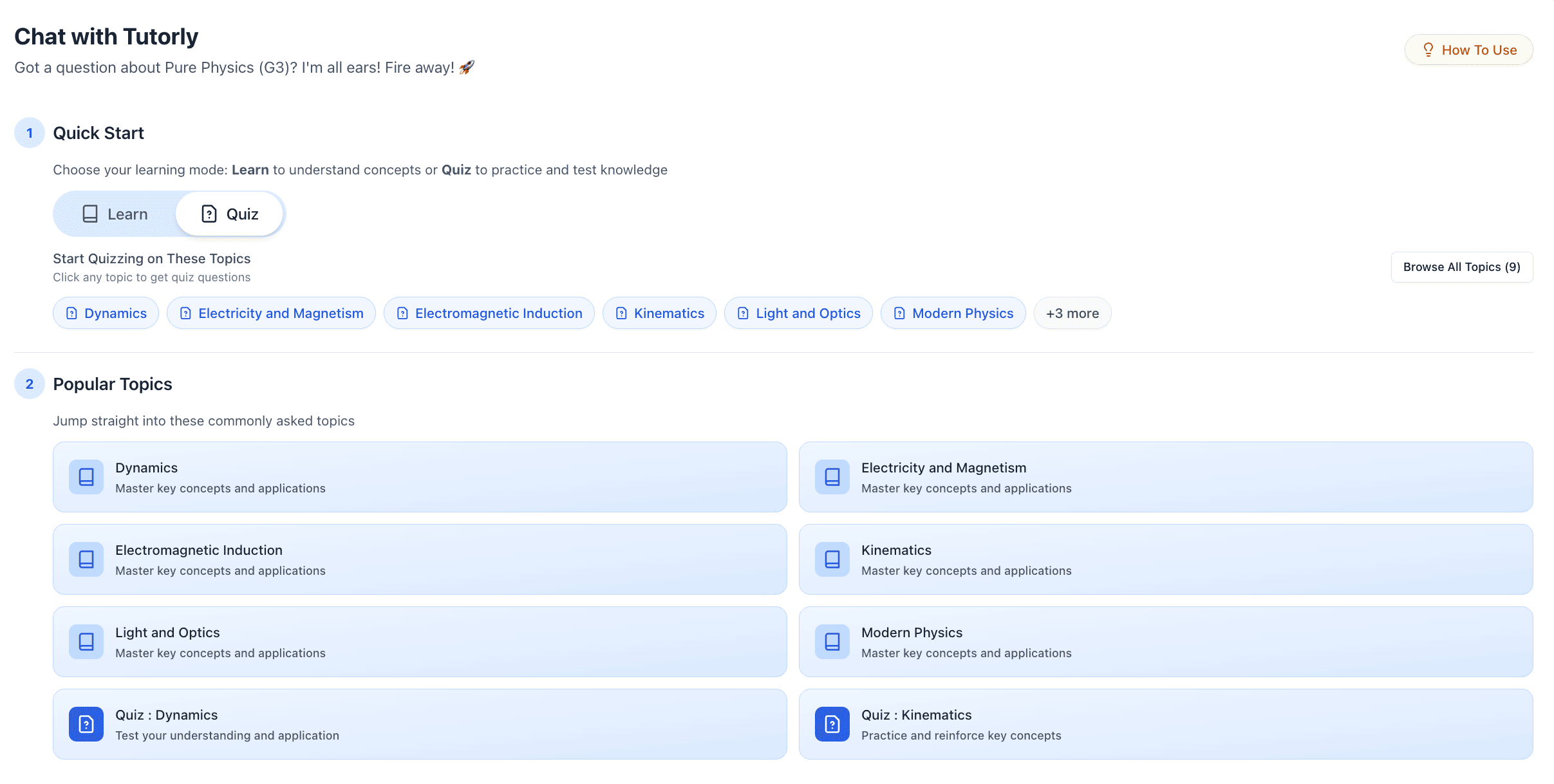 --- #### Question 5 – Algebraic fractions (harder) Simplify:$$$\frac{2}{𝑥} - + \frac{1}{𝑥(𝑥 - 1)}$$$**Step-by-step solution:** 1. Common denominator is 𝑥(𝑥 - 1). 2. Rewrite each term: - \dfrac{2}{𝑥} = \dfrac{2(𝑥 - 1)}{𝑥(𝑥 - 1)} - \dfrac{3}{𝑥 - 1} = \dfrac{3𝑥}{𝑥(𝑥 - 1)} - \dfrac{1}{𝑥(𝑥 - 1)} stays as it is. 3. Combine:$$$\frac{2(𝑥 - 1) - 3𝑥 + 1}{𝑥(𝑥 - 1)} = = You can factor out -1 if you want: = -Either form is usually accepted.
Question 6 – Quadratic with parameter
Given that has roots and , find the value of 𝑘.
Step-by-step solution:
If is a root:3^2 + 3 k - 12 = 09 + 3𝑘 - 12 = 03𝑘 - 3 = 0 3𝑘 = 3 𝑘 = 1Check with the other root :(-4)^2 + 1(-4) - 12 = 16 - 4 - 12 = 0So is consistent.
Question 7 – Linear + quadratic simultaneous equations
Solve:\begin{cases} 𝑦 = x + 2 \$$ 𝑥^2 + 𝑦^2 = 20 \end{cases}Step-by-step solution:
Substitute into the second equation:x^2 + (x + 2)^2 = 20𝑥^2 + (𝑥^2 + 4𝑥 + 4) = 202𝑥^2 + 4𝑥 + 4 = 202𝑥^2 + 4𝑥 - 16 = 0$$
Divide by 2:
Free on Tutorly.sg
Practise with step-by-step help — free to start
On Tutorly.sg/app you can practise unlimited Singapore syllabus questions, get instant explanations when you are stuck, and use past-year papers — no sign-up needed to start.
- ✓ PSLE, O Level, A Level, and more
- ✓ Step-by-step working when you are stuck
- ✓ Works on phone and laptop