

Free on Tutorly.sg
Practise with step-by-step help — free to start
On Tutorly.sg/app you can practise unlimited Singapore syllabus questions, get instant explanations when you are stuck, and use past-year papers — no sign-up needed to start.
- ✓ PSLE, O Level, A Level, and more
- ✓ Step-by-step working when you are stuck
- ✓ Works on phone and laptop
If you’re serious about improving your Secondary or O-Level results, “study more” is not enough.
You need to study your mistakes.
“Stuck on a question? See simple explanations that help you understand fast.”
👉 Give it a try and turn confusion into clarity in minutes.

In Singapore, most students are doing tons of worksheets, school papers, Ten-Year Series… but very few have a proper system to track mistakes. So they repeat the same errors in the SA 2, Prelims, then again in the O Levels.
You don’t need to be the smartest in class. You just need to be the one who stops repeating the same mistakes.
This guide will show you, step by step, how to build a simple, systematic mistake-tracking method that fits the MOE syllabus and Singapore exam style, especially for:
- Lower Sec (Sec 1–2)
- Upper Sec (Sec 3–), including O-Level and N-Level students
We’ll focus on how to:
- Track mistakes from school tests, mid-years, prelims, and practice papers
- Turn every error into a concrete action
- Use an AI tutor (Tutorly.sg) to check answers and generate targeted practice,
Tutorly.sg is a AI tutor website built specifically for Singapore students, aligned to the MOE syllabus. It has already been used by thousands of students in Singapore, and has even been mentioned on Channel NewsAsia (CNA). I’ll show you exactly how to use it as part of your mistake system.
Useful links (we’ll come back to them later):
- Main AI tutor: https://tutorly.sg/ai-tutor-singapore
- Web app: https://tutorly.sg/app
Step-by-step tutorial: Build your own mistake-tracking system
You don’t need anything fancy. The goal is consistency, not aesthetics.
You can do this with:
- A simple notebook (what I recommend), or
- A Google Sheet / Excel file, if you prefer digital
I’ll explain using a notebook first, then show how Tutorly.sg fits in.
Step 1: Create sections by subject
For Secondary / O-Level, you probably have at least:
- English
- Mathematics / A-Math
- Science (Pure / Combined Physics, Chemistry, Biology)
- Humanities (SS, History, Geography, Literature)
- Mother Tongue
In your mistake notebook, divide it into clear sections, e.g.:
- Section 1: E-Math
- Section 2: A-Math
- Section 3: Pure Chem
- Section 4: Pure Physics
- Section 5: English
- Section 6: SS
Use sticky tabs if you have them. The idea is: when you pick up your book, you can immediately jump to the right subject.
Step 2: Use a fixed format for every mistake
For every test, quiz, worksheet, or paper, you log your mistakes using the same template.
Write this at the top of a blank page in each subject section:
Mistake Entry Template
- Source:
- Question type / topic:
- What I wrote:
- Correct idea / concept:
- Why I made this mistake:
- Fix / rule for future:
Let’s see a few Secondary/O-Level specific examples.
Example (E-Math, Sec 3–4, Algebra)
- Source: Sec 3 Mid-Year Paper 1 Q 7
- Question type / topic: Simplifying algebraic fractions
- What I wrote:
I cancelled 𝑥 in to get , which is wrong. - Correct idea / concept:
You can only cancel common factors, not terms in a sum.
Correct simplification: cannot cancel directly; leave as or split into by dividing both terms by 𝑥. - Why I made this mistake:
I treated (𝑥+2) like and cancelled blindly. - Fix / rule for future:
Before cancelling, check: is it a product (everything multiplied) or a sum/difference?- Product → can cancel common factor
- Sum/difference → cannot cancel directly
Example (Pure Chemistry, Sec 4, Mole concept)
- Source: School Prelim Paper 2 Q 3 b
- Question type / topic: Mole calculations, limiting reagent
- What I wrote:
I used the mass of the excess reagent to calculate product, so my answer for mass of salt formed was too high. - Correct idea / concept:
Identify the limiting reagent first. Only the limiting reagent decides the amount of product. - Why I made this mistake:
I rushed and used the first mass given in the question without comparing moles. - Fix / rule for future:
For every mole question with 2 reactants:- Step 1: Convert both reactants to moles
- Step 2: Compare mole ratio with balanced equation
- Step 3: Decide limiting reagent
- Step 4: Use only limiting reagent to find product
Your entries don’t need to be perfect essays. Just be clear enough so that 2 weeks later, you can read and understand:
- What went wrong
- What you must do differently next time
Step 3: Tag each mistake by type
Next, you want to categorise errors so you can see patterns.
For each entry, add 1–2 tags from this list:
- C = Concept error (you didn’t understand the content)
- P = Procedure / method error (you knew the concept but used the wrong steps)
- R = Reading / misinterpretation (didn’t answer what the question asked)
- Cac = Careless (copying mistake, sign error, arithmetic slip)
- T = Time management (didn’t reach / rushed through the question)
Write the tags next to the entry title.
Example:
Sec 3 Mid-Year Paper 1 Q 7 — Algebraic fractions [C, P]
For Secondary/O-Level students, this is powerful because:
- If you see a lot of C in a topic → you need to revise notes / watch explanations
- If you see mostly Cac → you need better checking habits, not more content
- If you see many R in English / SS → you need to slow down and underline keywords
Step 4: Use Tutorly.sg to check answers and fill gaps
When you’re doing practice papers or Ten-Year Series at home, you don’t always have a teacher or tutor around.
This is where Tutorly.sg is very useful as part of your mistake system.
Go to: https://tutorly.sg/ai-tutor-singapore
Then:
- Select your level and subject (e.g. Sec 4, E-Math / Pure Chem / English).
- Type or paste the question you’re doing.
- Enter your final answer.
Tutorly will:
- Tell you if the final answer is correct or wrong
- Show you a step-by-step worked solution for that question
- Explain the concept in a way that matches MOE / O-Level style
Important: Tutorly does not check every step of your working. It checks your final answer, then shows you how to solve it properly.
How this helps your mistake-tracking:
- If your answer is wrong, read the solution and compare with your own.
- Then immediately fill in your mistake template:
- What you did vs what the correct solution did
- Why your approach failed
- What rule or method you must remember
You can also ask Tutorly:
- “Give me 3 more practice questions on limiting reagents, Sec 4 Pure Chem, similar to this one but slightly harder.”
- “Explain why my approach to this algebra question is wrong, in simple terms.”
The website is available , so you can fix mistakes the same night you do the paper, instead of waiting a week for your teacher to go through it in class.
Use this link whenever you’re practising:
https://tutorly.sg/app
Step 5: Do a weekly “mistake review”
Mistakes only help you if you revisit them.
Once a week (for example, Sunday night), spend 30–45 minutes on a “mistake review” session:
- Open your mistake notebook.
- Pick 1–2 subjects (e.g. Math and Chem).
- Read through the last 1–2 weeks of entries.
- For each entry, cover the solution and try to:
- Restate the concept or rule in your own words
- Do a similar question from your textbook / school worksheet / Tutorly.sg
If you keep doing this, by the time SA 2 or O Levels come, you’ll have:
- A personal book of “Things I Must Not Mess Up Again”
- A clear idea of which topics still need urgent revision
Exam strategy guide: Using mistake-tracking to score higher
Once you have your system, you can change how you approach exams.
“Access more than 1000+ past year papers to practice”
👉 Start a paper today and test yourself like it’s the real exam.

1. Before exams: Plan revision around your mistakes
Don’t just revise in the order of your textbook.
Use your mistake notebook to decide what matters most.
For Math (E-Math / A-Math)
Look at your algebra, graphs, and geometry entries. Ask:
- Which topic has the most concept errors (C)?
- Which topic has many procedure errors (P)?
Prioritise your revision like this:
- Topics with many C and P mistakes (e.g. Trigonometry, Quadratic Equations)
- Topics that are heavily tested in O Levels (algebra, graphs, geometry, trig)
- Only then, the smaller topics
For each high-priority topic:
- Do 5–10 targeted questions
- Check with Tutorly.sg
- Add any new mistakes to your notebook
For Science (Pure / Combined)
Use your entries to spot:
- Concepts you keep misunderstanding (e.g. electrolysis, mole, kinematics, energy)
- Skills you keep messing up (e.g. drawing graphs, describing experiments, explaining trends)
Then:
- Revisit your school notes or textbook
- Use Tutorly.sg to ask for:
- “Explain electrolysis of aqueous sodium chloride, Sec 4 Pure Chem, in exam style.”
- “Give me 3 O-Level style questions on kinematics graphs, with answers.”
For English & Humanities
Your mistake entries should include:
- Comprehension question types you keep losing marks on
- Summary word limit issues
- Essay structure problems
- SS/History/Geography question types (e.g. “Explain”, “Account for”, “To what extent”)
Before exams:
- Collect your common phrases or sentence structures that work
- Note common question keywords and what they require
- Ask Tutorly.sg to generate practice questions in those formats
Example prompt:
“Give me 3 Sec 4 Social Studies structured questions on governance in Singapore, with sample answers and mark breakdown.”
2. During exams: Avoid repeating known mistakes
Your mistake notebook should be in your brain during the paper.
Here’s how to apply it.
In Math papers
As you do each question, quickly scan for your old error patterns:
- Algebraic fractions → “Wait, can I actually cancel this, or is it a sum?”
- Trig → “Am I using degrees or radians? Did I set the calculator correctly?”
- Graphs → “Did I label axes and scale properly?”
Use 10–15 seconds per question to ask:
“Is this one of my usual trap areas?”
If yes, slow down just a bit.
At the end, if you have time, do a targeted check:
- Only check questions in topics where you have many Cac tags
- Recalculate key values, re-check signs, units, and copying from calculator
In Science papers
For structured and data-based questions:
- Check if you’ve used the correct scientific terms (e.g. “rate of reaction” vs “speed of reaction”)
- Make sure you answered all parts (a), (b), (c) — a common reading mistake
If your mistake notebook shows that you always:
- Forget to mention “control variables”
- Fail to refer to the graph/data in your explanation
Then during the exam, mentally remind yourself:
“For experiment questions: always mention aim, variables, and how to measure.”
In English & Humanities papers
If you often:
- Misread the question
- Miss key words like “Explain how far”, “To what extent”, “Compare”
Then, during the exam:
- Underline question keywords.
- Quickly write a mini-plan before answering.
Free on Tutorly.sg
Practise with step-by-step help — free to start
On Tutorly.sg/app you can practise unlimited Singapore syllabus questions, get instant explanations when you are stuck, and use past-year papers — no sign-up needed to start.
- ✓ PSLE, O Level, A Level, and more
- ✓ Step-by-step working when you are stuck
- ✓ Works on phone and laptop
For example, SS “How far do you agree” question:
- 2 points supporting the statement
- 1–2 points against
- Conclusion that directly answers “how far”
This is based on your past mistakes. You’re not guessing anymore.
3. After exams: Turn your paper into a goldmine
When you get back any test or exam paper:
- Don’t just check your marks and throw it aside.
- For every question you lost marks on, ask:
- Was this a concept, procedure, reading, careless, or time problem?
- Log the important ones into your mistake notebook.
Then, at home:
- Use Tutorly.sg to re-do similar questions
- Ask for step-by-step solutions
- Add any new insights into your “Fix / rule for future”
This way, every exam (even a bad one) pushes your level up.
Worksheet practice: Turn mistakes into targeted drills
Now let’s talk about how to practise smart, not just “do more papers”.
We’ll use 3 levels of questions:
- Direct basics – to fix concept gaps
- Exam-style – similar to school and O-Level questions
- Hard variants – slightly trickier versions that force you to think
I’ll give sample question types and how to use Tutorly.sg with them.
1. Math example: Algebra & Functions (Sec 3–4, E-Math)
Level 1: Direct basics
Goal: Make sure you don’t stumble over fundamentals.
Examples:
-
Simplify:
-
Solve for 𝑥:
Do a small set (5–10 questions). Then:
- Check your answers with Tutorly.sg
- For any wrong answers, immediately log the mistake
Prompt example:
“I’m Sec 3 E-Math. I did these questions:
- Simplify 3 x / (6 x^2)
- Simplify 2 x^2 y / (4xy^3)
My answers: 1) 1/(2 x) 2) x/y^2
Are they correct? If not, show me the correct working step-by-step.”
Level 2: Exam-style
Now move to questions that look like real exam ones:
- Solve the simultaneous equations:
\begin{cases} 2𝑥 + 3𝑦 = 12 \\ 𝑥 - 𝑦 = 1 \end{cases}- 𝐴 function 𝑓 is defined by 𝑓(𝑥) = 2𝑥 - 3. - (𝑎) Find 𝑓(4). - (𝑏) Solve 𝑓(𝑥) = 7. Again, do 𝑎 set, then check with [Tutorly.sg](https://tutorly.sg/app) and record any mistakes. #### Level 3: Hard variants (𝑂-Level style twist) Harder versions might combine topics or add 𝑎 small trick. Examples: 1. The function 𝑓 is defined by 𝑓(𝑥) = \dfrac{2𝑥-1}{𝑥+3} for 𝑥 \neq -3. - (𝑎) Find 𝑓(1). - (𝑏) Solve 𝑓(𝑥) = 1. 2. Solve:\dfrac{2}{𝑥-1} + \dfrac{3}{𝑥+2} = 1These are the type that often cause **careless algebra** or **procedure** mistakes. For hard variants, tell [Tutorly.sg](https://tutorly.sg/app): > “Give me 5 harder Sec 4 𝐸-Math algebra questions that combine algebraic fractions and solving equations, similar to 𝑂-Level Paper 2 style. Provide full worked solutions.” Then: - Attempt them on your own first - Check answers - Log any mistakes ### 2. Science example: Chemistry (Mole concept, Sec 4 Pure/Combined) #### Level 1: Direct basics - Calculate the number of moles in: 1. 10 𝑔 of sodium (\text{Na}) 2. 44 𝑔 of carbon dioxide (\text{CO}_2) - Calculate the mass of: 1. 0.5 mol of magnesium (\text{Mg}) 2. 0.25 mol of water (\text{H}_2\text{O}) Ask [Tutorly.sg](https://tutorly.sg/app) to: > “Check my answers for these mole calculations and show me step-by-step solutions.” #### Level 2: Exam-style > “Doing Secondary Science? Pick 𝑎 topic and practise like it’𝑠 𝑎 real exam — with clear answers right after.” > [👉 Try Tutorly now and start 𝑎 Science topic in seconds.](https://tutorly.sg/app) 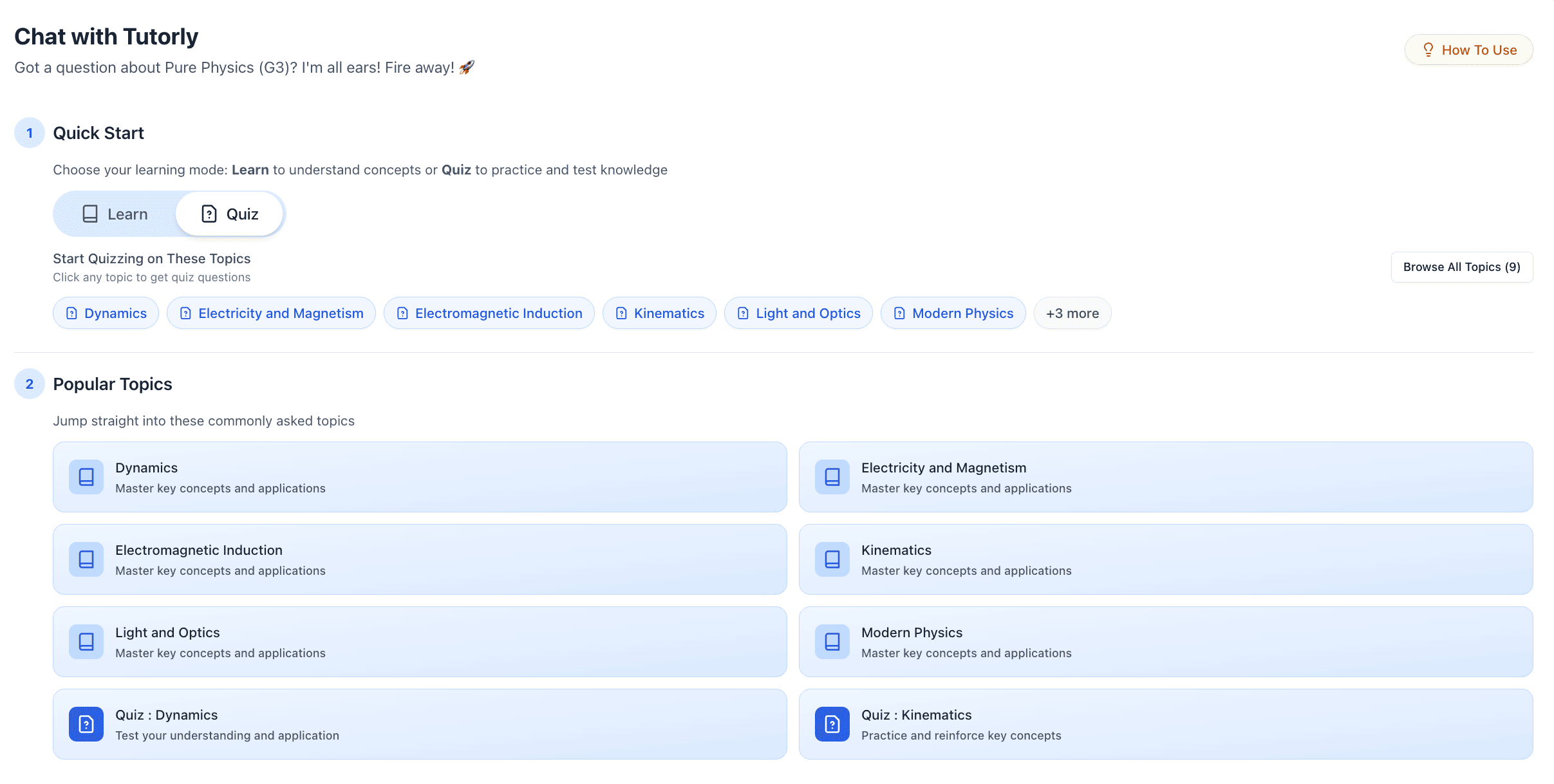 - Magnesium reacts with dilute hydrochloric acid according to the equation:\text{Mg} + 2\text{HCl} \rightarrow \text{MgCl}_2 + \text{H}_2$$
0.6 g of magnesium reacts completely.- (a) Calculate the number of moles of magnesium used.
- (b) Calculate the number of moles of hydrogen gas produced.
- (c) Calculate the volume of hydrogen gas at r.t.p. (1 mol of gas occupies 24 dm³ at r.t.p.).
Level 3: Hard variants (Limiting reagent + gas)
Harder question:
4.0 g of magnesium ribbon is added to 200 cm³ of 1.0 mol/dm³ hydrochloric acid.
(a) Calculate the number of moles of:
- magnesium
- hydrochloric acid
(b) Identify the limiting reagent and explain your reasoning.
(c) Calculate the volume of hydrogen gas produced at r.t.p.
This is the type that often appears in prelims and O Levels, and many students mis-handle the limiting reagent part.
After attempting:
- Use Tutorly.sg to get the full worked solution
- Compare with your working
- Log any conceptual errors in your notebook
3. Humanities example: Social Studies (Sec 3–4)
Level 1: Direct basics – understanding question types
Write down 3–5 question stems and classify them:
- “Explain how far you agree with the view…” → Evaluation
- “Describe two ways in which…” → Factual
- “Account for the success of…” → Explanation
Ask Tutorly.sg:
“Explain the difference between ‘explain’, ‘account for’, and ‘how far do you agree’ question types in Sec 4 Social Studies, with example answers and marking points.”
Log any misunderstandings into your mistake notebook.
Level 2: Exam-style structured questions
Example:
“Explain two reasons why the government of Singapore invests heavily in education.” (8 marks)
Write your answer, then ask Tutorly.sg:
“Here is my Sec 4 SS answer to this 8-mark question: [paste question + your answer].
Mark it according to O-Level style and tell me:
- Likely mark /8
- Where I lost marks
- How to improve each paragraph.”
Use the feedback to:
- Identify if your issue is content, structure, or linking back to the question
- Log the main mistake and the improved structure in your notebook
Level 3: Hard variants – “How far do you agree”
These are usually the killers.
Example:
“How far do you agree that effective governance is the most important factor that contributed to Singapore’s success? Explain your answer.” (12 marks)
Write a full answer. Then:
- Ask Tutorly.sg to mark and comment
- Compare your structure with its suggested model answer
- Add to your mistake notebook:
- How many points for each side
- How to write a conclusion that actually answers “how far”
Common mistakes: Why most students’ “error logs” fail
Many students try to “track mistakes” but stop after 1–2 weeks because it feels useless or too troublesome. Usually, it’s because of these common issues.
1. Writing too much, too vague
Problem:
- Long paragraphs like “I’m just careless” or “I don’t understand this topic”
- No specific rule or action
Fix:
- Keep entries short and sharp
- Always end with a clear rule or step, e.g.:
- “Always check if denominator is 0 for domain questions.”
- “For ‘how far’ questions: at least 1 point against + clear conclusion.”
2. Only tracking marks, not patterns
Problem:
- You only record scores: “Math test: 62%”, “Chem: 58%”
- You don’t record what kind of mistakes led to those marks
Fix:
- Use the tags (C, P, R, Cac, T)
- After a few weeks, count:
- “I have 8 Cac in algebra but 0 C in algebra” → focus on checking
- “I have 10 C in mole concept” → go back to basics, re-learn with Tutorly.sg
3. Tracking but never reviewing
Problem:
- You write mistakes down once
- You never look at them again
Fix:
- Schedule a weekly 30–45 min review
- Before major exams (Mid-Year, Prelims, O Levels), spend 1–2 hours just going through your mistake notebook and re-doing key questions
4. Not linking mistakes to actual practice
Problem:
- You write, “I always mess up limiting reagent”
- But you don’t actually do more limiting reagent questions
Fix:
- For each major mistake pattern, do a mini drill:
- 5–10 questions on that exact thing
- Check with Tutorly.sg
- Log any new errors
5. Depending only on school answers
Problem:
- You wait for teachers to go through papers
- Sometimes the explanation is too fast or too short
Fix:
- After school, use Tutorly.sg to:
- Rebuild the solution slowly
- Ask follow-up questions in your own words
- Generate similar questions until you’re comfortable
Start now: Build your own mistake system with Tutorly.sg
You don’t need to wait for the next term or next exam.
Here’s what you can do today:
- Prepare your notebook
- Divide it by subject
- Write your mistake template at the top
“Practice PSLE Science questions and get clear, step-by-step answers instantly.”
👉 Try a question now and see how fast you can improve.

Ready to practise?
If you want a Singapore-focused AI tutor you can use immediately (website, no sign-up), try Tutorly here:
Related Articles
Free on Tutorly.sg
Practise with step-by-step help — free to start
On Tutorly.sg/app you can practise unlimited Singapore syllabus questions, get instant explanations when you are stuck, and use past-year papers — no sign-up needed to start.
- ✓ PSLE, O Level, A Level, and more
- ✓ Step-by-step working when you are stuck
- ✓ Works on phone and laptop