

Free on Tutorly.sg
Practise with step-by-step help — free to start
On Tutorly.sg/app you can practise unlimited Singapore syllabus questions, get instant explanations when you are stuck, and use past-year papers — no sign-up needed to start.
- ✓ PSLE, O Level, A Level, and more
- ✓ Step-by-step working when you are stuck
- ✓ Works on phone and laptop
If you’ve ever walked out of an exam thinking, “I knew how to do that question, but I still lost marks…”, this article is for you.
In Singapore, especially at the Secondary and O-Level stages, your working is often worth more marks than the final answer. MOE exam setters design questions so that even if your final answer is wrong, you can still score method marks if your steps are correct.
“Stuck on a question? See simple explanations that help you understand fast.”
👉 Give it a try and turn confusion into clarity in minutes.

The problem? Many students know the method, but they don’t show it clearly enough for the marker to award full marks.
You’re going to learn:
- How examiners in Singapore actually give method marks
- How to write working that is “marker-friendly”
- Specific step-by-step examples for common O-Level question types
- How to practise using hard variants (not just basic textbook questions)
- How to use an AI tutor like Tutorly.sg to build consistent, exam-ready working
Tutorly.sg is a AI tutor website built specifically for the Singapore MOE syllabus (Primary 1 to JC 2). It’s been mentioned on Channel NewsAsia (CNA) and used by thousands of students in Singapore, especially for exam prep and step-by-step solutions.
Let’s focus on what really matters for your O Levels: full marks for working.
Step-by-step tutorial
We’ll walk through how to show full working in three big O-Level areas:
- Maths (E-Maths / A-Maths style)
- Science (Physics / Chemistry / Biology)
- Humanities (SS / History / Geography – structure and reasoning)
1. Maths: How to write working that earns every method mark
In O-Level Maths, most long questions are marked using a mix of:
- Method marks (M): For using the correct method
- Accuracy marks (A): For correct calculations
- Communication marks (C): For clear, logical presentation
Your goal is: never lose M or C marks just because your steps are messy or missing.
Example 1: Algebra solving question
Question (E-Maths style):
Solve .
Weak student working (what many actually write):
This is too short. If the examiner doubts your mental steps, you risk losing method marks, especially if your answer is wrong.
Marker-friendly working:
\begin{aligned} 3(2 x - 1) &= 5 x + 7 \ 6 x - 3 &= 5 x + 7 \ 6 x - 5 x &= 7 + 3 \ x &= 10 \end{aligned}
Why this gets full method marks:
- Every algebra move is shown: expanding, moving terms, simplifying
- Equal signs are lined up vertically
- No big jumps
Rule for yourself: For any solving question, show at least 3–4 lines of algebra, even if you can do it mentally.
Example 2: Simultaneous equations (common O-Level target)
Question:
Solve the simultaneous equations:
\begin{cases} 2𝑥 + 3𝑦 = 7 \\ 𝑥 - 𝑦 = 1 \end{cases}Good working (elimination method):\begin{aligned} 𝑥 - 𝑦 &= 1 \quad \text{(1)} \ 2𝑥 + 3𝑦 &= 7 \quad \text{(2)} \ \text{From (1)},\ 𝑥 &= 1 + 𝑦 \ \text{Substitute into (2): } 2(1 + 𝑦) + 3𝑦 &= 7 \$$ 2 + 2 y + 3 y &= 7 \ 5 y &= 5 \ y &= 1 \ x &= 1 + 𝑦 = 1 + 1 = 2 \end{aligned}Notice:
- You labelled the equations (1) and (2) – this helps the marker follow
- You clearly stated “Substitute into (2)” – that’s a method step
- You solved systematically, one variable at a time
Even if you made a small arithmetic slip at the end, the method marks are mostly safe.
Example 3: Trigonometry (where many lose marks)
Question (O-Level E-Maths style):
In , cm, \angle ACB = 30^\circ, and \angle ABC = 90^\circ. Find the length of AC.
Full working example:\begin{aligned} \text{Given } \angle B &= 90^\circ,\ \angle 𝐶 = 30^\circ \ \text{So } \angle A &= 180^\circ - 90^\circ - 30^\circ = 60^\circ \ \text{In right-angled } \triangle ABC: \ \frac{AB}{AC} &= \cos \angle A \ \frac{10}{AC} &= \cos 60^\circ \ \frac{10}{AC} &= \frac{1}{2} \ AC &= 10 \div \frac{1}{2} = 20\ \text{cm} \end{aligned}Why this is strong: - You stated the angle you’re using - You wrote the trig ratio before substituting numbers - You showed the fraction step before the final answer **Key habits for Maths working:** - Always write the formula first (𝑒.𝑔. 𝐴 = \frac{1}{2}bh, 𝑣 = 𝑢 + at) - Then substitute numbers - Then simplify step-by-step - Use clear, separate lines – don’𝑡 cram everything into one --- ### 2. Science: Working = formula + substitution + units In 𝑂-Level Physics and Chemistry, you get method marks for: - Choosing the correct formula - Substituting values correctly - Showing at least one intermediate step - Including **units** in your final answer #### Example 4: Physics – speed / acceleration **Question:** 𝐴 car accelerates from 10\ \text{m s}^{-1} to 22\ \text{m s}^{-1} in 4 𝑠. Find its acceleration. **Full working:**\begin{aligned} \text{Given: } u &= 10\ \text{m s}^{-1},\ 𝑣 = 22\ \text{m s}^{-1},\ 𝑡 = 4\ \text{s} \ \text{Formula: } a &= \frac{v - u}{t} \ a &= \frac{22 - 10}{4} \ a &= \frac{12}{4} = 3\ \text{m s}^{-2} \end{aligned}Markers love:
- “Given” line – shows you identified the variables correctly
- Formula written before substituting
- Proper unit in the final answer
Even if you mis-copied a number, your method marks are safe.
Example 5: Chemistry – mole calculations
Question:
What is the number of moles in 9 g of water, ? (Relative atomic masses: 𝐻 = 1, 𝑂 = 16)
Full working:\begin{aligned} \text{Molar mass of } H_2 O &= (2 \times 1) + 16 = 18\ \text{g mol}^{-1} \ \text{Formula: } n &= \frac{m}{M} \ n &= \frac{9}{18} \ n &= 0.50\ \text{mol} \end{aligned}$$
Again, you:
- Showed how you got 18
- Wrote the formula
- Simplified step-by-step
3. Humanities: Working = structure + explanation
For subjects like Social Studies, History, and Geography, “working” is not numbers – it’s how you structure and explain your answer.
Markers award method marks for:
- Using a clear structure (e.g. PEEL: Point, Evidence, Explanation, Link)
- Directly answering the question
- Explaining cause-effect or comparison clearly
Example 6: Social Studies 5 m part (PEEL)
Question:
Explain how globalisation has affected workers in Singapore.
Strong paragraph (showing ‘working’):
Globalisation has created more job opportunities for workers in Singapore.
Point: With more multinational corporations (MNCs) setting up regional headquarters here, there is higher demand for skilled workers.
Evidence: For example, many tech companies and financial institutions choose Singapore because of our stable government and good infrastructure.
Explanation: This means Singaporean workers can access higher-paying jobs in sectors like banking, IT, and biotechnology, improving their standard of living.
Link: Therefore, globalisation has benefited workers by increasing employment opportunities and wages, especially for those with higher skills.
Even if your content isn’t perfect, this structure shows clear reasoning, which earns method/structure marks.
Exam strategy guide
Now that you’ve seen what good working looks like, let’s talk strategy: how to actually secure full marks for working under exam conditions.
“Access more than 1000+ past year papers to practice”
👉 Start a paper today and test yourself like it’s the real exam.

Strategy 1: Know where method marks are hiding
In O-Level exam papers (especially Maths and Science), method marks usually appear when you:
- Choose a formula
- Rearrange an equation
- Substitute numbers
- Use a correct concept (e.g. “Use Pythagoras”, “Use conservation of energy”)
- Draw a correct diagram or table (for some questions)
So during practice, ask yourself:
“If my answer is wrong, will the marker still see what I was trying to do?”
If the answer is “No”, your working is too short or unclear.
Strategy 2: Train yourself to write “exam-style” working every time
Don’t wait until prelims to practise proper working. Make it your default during:
- Homework
- School tests
- Topical practice
- Revision worksheets
For every question:
- Underline or circle key data in the question.
- Write down “Given:” and list the important values (especially for Physics).
- Write the formula first.
- Substitute clearly in the next line.
- Simplify step-by-step, one operation per line if possible.
- Box or underline your final answer with units.
It will feel slower at first, but after a few weeks it becomes automatic and actually reduces careless mistakes.
Strategy 3: Use past-year questions the right way
When you do TYS or school papers, don’t just check if your final answer matches the answer key.
Do this instead:
-
Mark your answers.
-
For any question you got wrong, ask:
- “Was my method correct but my arithmetic wrong?”
- “Did I skip steps that the examiner might not understand?”
- “Did I use the wrong concept or formula?”
-
Rewrite the entire solution with proper working, even if you now know the answer.
This re-training is what actually upgrades your exam performance.
To speed this up, you can use Tutorly.sg:
- Type in the question you’re stuck on
- Get a full, step-by-step solution aligned with MOE style
- Compare your working line-by-line with Tutorly’s steps
- Adjust how you write your own working for similar questions next time
Remember: Tutorly checks your final answer, then shows you the steps to get there. Use those steps as a model for how you should present your working in exams.
Strategy 4: Time management with working
You might worry: “If I write so many steps, I’ll run out of time.”
Here’s how to balance speed and working:
- For 1–2 mark questions: Shorter working is fine, but still show at least one clear step.
- For 3–5 mark questions: Always show formula → substitution → simplification.
- For 6–10 mark structured questions: Break them into parts (a), (b), (c) and treat each part like its own mini-question with full working.
During practice:
- Time yourself for full papers
- Don’t skip working just to finish faster
- Instead, practise writing working more efficiently (less writing, but still clear and logically complete)
Over time, you’ll find a rhythm where your working is both complete and fast.
Free on Tutorly.sg
Practise with step-by-step help — free to start
On Tutorly.sg/app you can practise unlimited Singapore syllabus questions, get instant explanations when you are stuck, and use past-year papers — no sign-up needed to start.
- ✓ PSLE, O Level, A Level, and more
- ✓ Step-by-step working when you are stuck
- ✓ Works on phone and laptop
Strategy 5: Use AI tutoring wisely (not passively)
If you just copy answers from any website, you don’t improve.
With Tutorly.sg, you can do this instead:
-
Try the question yourself first.
-
Enter the question into Tutorly and check your final answer.
-
If wrong, study the step-by-step solution carefully.
-
Ask Tutorly follow-up questions like:
- “Why did you use this formula instead of that one?”
- “Can you show an alternative method?”
- “Which line would get the method mark if my answer is wrong?”
-
Redo a similar question on your own without looking.
Because Tutorly is built specifically for the Singapore MOE syllabus (PSLE, N Level, O Level, A Level), the style of working it shows is very close to what markers expect.
You can try it anytime at:
AI tutor (Singapore-specific): https://tutorly.sg/ai-tutor-singapore
Worksheet practice
Let’s go through some practice questions together, including harder exam-style variants. I’ll show the kind of working that secures method marks.
You can later create your own similar questions and use Tutorly.sg to check your answers and see full solutions.
Section A: Maths – from standard to hard variants
Q 1 (Standard algebra)
Solve .
Working:
Q 2 (Standard quadratic)
Solve .
Working:
Notice: You showed the factorisation step and the “or” step – both are method marks.
Q 3 (Harder variant – word problem to equation)
Question:
A class has 𝑥 boys and 𝑦 girls. The ratio of boys to girls is 3:5. There are 8 more girls than boys. Form two equations in 𝑥 and 𝑦 and solve them.
Working:
\begin{aligned} \text{Given ratio } \frac{𝑥}{𝑦} &= \frac{3}{5} \\ 5𝑥 &= 3𝑦 \quad \text{(1)} \\ \text{Given } 𝑦 &= 𝑥 + 8 \quad \text{(2)} \\ \text{Substitute (2) into (1): } 5𝑥 &= 3(𝑥 + 8) \\ 5 x &= 3 x + 24 \ 5 x - 3 x &= 24 \ 2 x &= 24 \ x &= 12 \ y &= x + 8 = 12 + 8 = 20 \end{aligned}You’ve shown:
- How you turned the ratio into an equation
- How you turned the difference into another equation
- Clear substitution and solving steps
Even if you mis-copied 8 as 6, you’d still keep most of the method marks.
Q 4 (Harder variant – non-obvious trig)
Question:
In , cm, cm, and \angle BAC = 30^\circ. Find the length of BC, correct to 3 significant figures.
Working (cosine rule):\begin{aligned} \text{Given: } AB &= 7,\ AC = 10,\ \angle BAC = 30^\circ \ \text{Using cosine rule: } BC^2 &= AB^2 + AC^2 - 2(AB)(AC)\cos \angle BAC \ BC^2 &= 7^2 + 10^2 - 2(7)(10)\cos 30^\circ \ BC^2 &= 49 + 100 - 140 \left(\frac{\sqrt{3}}{2}\right) \ BC^2 &= 149 - 70\sqrt{3} \ BC &\approx \sqrt{149 - 70(1.732)} \ BC &\approx \sqrt{149 - 121.24} \ BC &\approx \sqrt{27.76} \ BC &\approx 5.27\ \text{cm (3 s.f.)} \end{aligned}Why this is good: - You clearly stated “Using cosine rule” – concept mark - You wrote the full formula first - You showed substitution and intermediate values - You rounded only at the end --- ### Section 𝐵: Science – including tricky variants #### 𝑄5 (Standard Physics) **Question:** 𝐴 ball is dropped from rest and takes 3.0 𝑠 to reach the ground. Take 𝑔 = 10\ \text{m s}^{-2}. Find the speed of the ball just before it hits the ground. **Working:**\begin{aligned} \text{Given: } 𝑢 &= 0,\ 𝑡 = 3.0\ \text{s},\ 𝑎 = 𝑔 = 10\ \text{m s}^{-2} \ \text{Formula: } 𝑣 &= 𝑢 + at \ 𝑣 &= 0 + (10)(3.0) \\ 𝑣 &= 30\ \text{m s}^{-1} \end{aligned}--- #### 𝑄6 (Harder Physics – two-step) > “Doing Secondary Science? Pick 𝑎 topic and practise like it’𝑠 𝑎 real exam — with clear answers right after.” > 👉 Try Tutorly now and start 𝑎 Science topic in seconds. 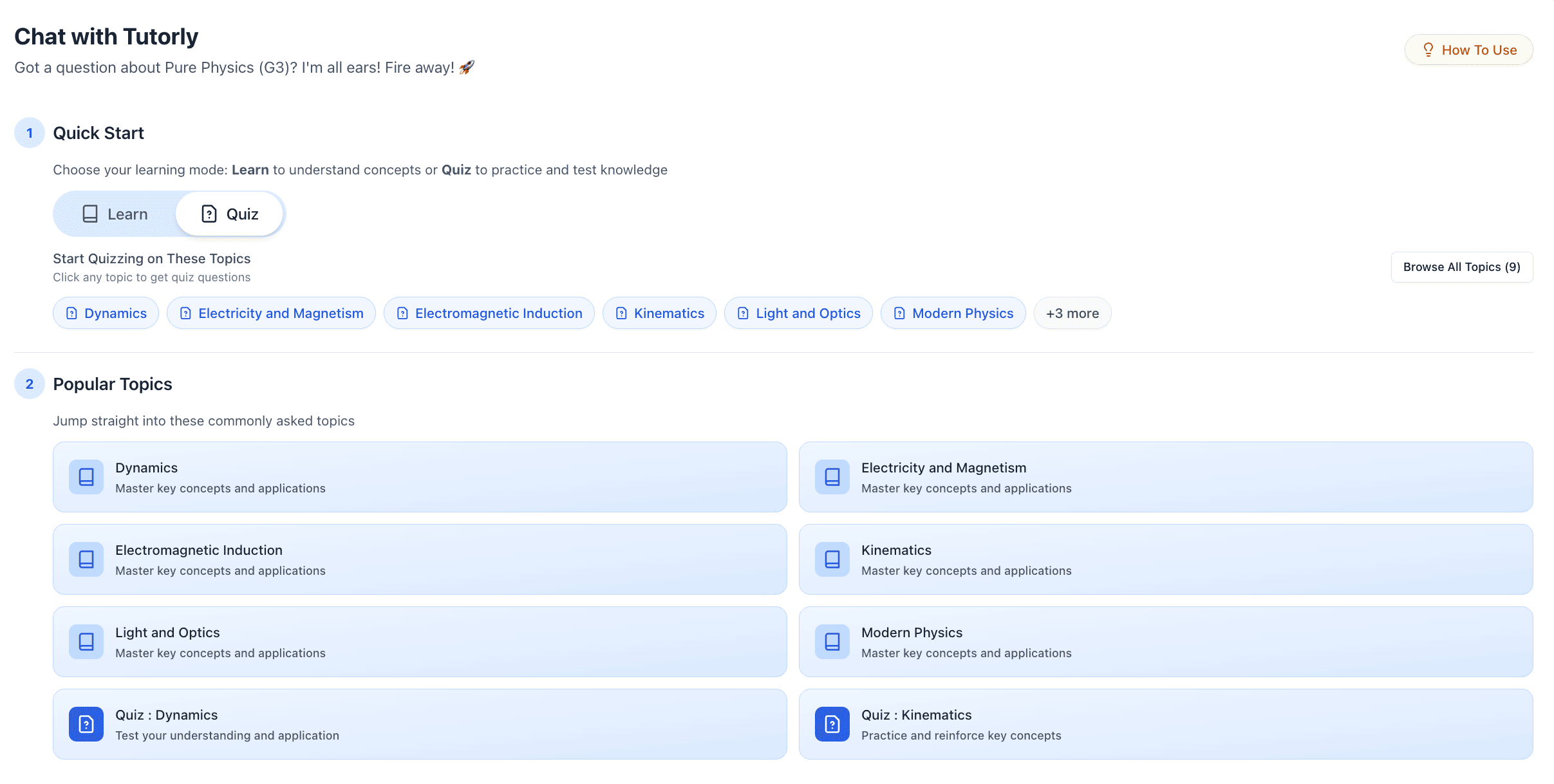 Question: 𝐴 car moves at 𝑎 constant speed of 20\ \text{m s}^{-1} for 30 𝑠, then accelerates uniformly to 30\ \text{m s}^{-1} in the next 10 𝑠. (𝑎) Find the total distance travelled in the 40 𝑠. (𝑏) Find the average speed over the 40 𝑠. Working: (𝑎) First 30 𝑠 (constant speed):
Next 10 𝑠 (accelerating):
Total distance:
(𝑏) Average speed:
Every formula and substitution is shown – method marks are safe. --- ### Section 𝐶: Humanities – structure practice #### 𝑄7 (Standard SS 5𝑚 “Explain”) Question: Explain one reason why the Singapore government invests heavily in education. Model “working” (PEEL): > Point: The Singapore government invests heavily in education to ensure 𝑎 skilled workforce. > > Evidence: For example, it provides subsidies for primary to tertiary education and partners with industries to design courses in polytechnics and ITEs. > > Explanation: This helps workers gain relevant skills for sectors like finance, technology, and biomedical sciences, making Singapore more attractive to investors and MNCs. With 𝑎 more skilled workforce, the economy can grow and remain competitive globally. > > Link: Therefore, investing in education helps Singapore maintain 𝑎 strong and competitive economy through 𝑎 well-trained workforce. Even if your example isn’𝑡 perfect, this structure shows clear reasoning and usually secures method marks. --- ### How to turn these into real worksheets To really benefit: 1. Copy 5–10 questions from your school worksheets, assessment books, or TYS. 2. Do them under timed conditions. 3. After finishing, enter the ones you are unsure about into Tutorly.sg. 4. Compare your working with Tutorly’𝑠 step-by-step solution. 5. Rewrite one or two solutions per day to improve your working style. This is how you build exam-ready habits before your school exams and 𝑂 Levels. --- ## Common mistakes Let’𝑠 fix the habits that quietly kill your method marks. ### Mistake 1: Skipping formulas Many students jump straight into numbers: > 3 \times 4 \div 2 = 6\ \text{cm}^2 instead of:Markers may not know which formula you used, especially if the question is more complex. Always write the formula first. --- ### Mistake 2: Doing everything in one line Example: > 𝑣 = 𝑢 + at = 5 + 2 \times 3 = 11\ \text{m s}^{-1} Better:
This makes it clear where your numbers come from and reduces careless mistakes.
Mistake 3: No units or wrong units
You can lose marks even if your number is correct.
- Always include units in your final answer
- For Physics and Chemistry, be careful with things like:
If you’re not sure, ask Tutorly:
“What are the correct SI units for this answer?”
and adjust your working accordingly.
Try Tutorly.sg (Singapore)
Start here: AI Tutor Singapore
Try Tutorly on the website (no sign-up): https://tutorly.sg/app
“Practice PSLE Science questions and get clear, step-by-step answers instantly.”
👉 Try a question now and see how fast you can improve.

Ready to practise?
If you want a Singapore-focused AI tutor you can use immediately (website, no sign-up), try Tutorly here:
Related Articles
Free on Tutorly.sg
Practise with step-by-step help — free to start
On Tutorly.sg/app you can practise unlimited Singapore syllabus questions, get instant explanations when you are stuck, and use past-year papers — no sign-up needed to start.
- ✓ PSLE, O Level, A Level, and more
- ✓ Step-by-step working when you are stuck
- ✓ Works on phone and laptop