

Free on Tutorly.sg
Practise with step-by-step help — free to start
On Tutorly.sg/app you can practise unlimited Singapore syllabus questions, get instant explanations when you are stuck, and use past-year papers — no sign-up needed to start.
- ✓ PSLE, O Level, A Level, and more
- ✓ Step-by-step working when you are stuck
- ✓ Works on phone and laptop
If you’re choosing the best tuition for primary school in Singapore, start by asking:
- What does my child actually need help with (content, confidence, or exam skills)?
- Which option matches that need: private tutor, tuition centre, or an on-demand AI tutor like Tutorly.sg?
Full centre review: AGrader Learning Centre Review Singapore 2026 — 2026 fees, pros, cons, branches, and how Tutorly.sg complements weekly classes.
From there, compare price, flexibility, and how quickly your child can get help before tests and PSLE. The “best” tuition isn’t the most expensive one; it’s the one that fits your child’s learning style, schedule, and the MOE syllabus.
“Stuck on a question? See simple explanations that help you understand fast.”
👉 Give it a try and turn confusion into clarity in minutes.

Most parents here already know: primary school isn’t “easy” anymore.
P 3–P 6 means:
- Heavier homework
- Heavier topics (model drawing, composition, science open-ended)
- And finally, PSLE
You don’t want to throw money at random tuition and hope for the best. You want a clear way to choose.
In this guide, I’ll walk you through:
- A step-by-step method to choose the best primary tuition in Singapore
- An exam strategy guide focused on PSLE-style thinking
- Worksheet-style practice (including harder variants)
- Common mistakes parents make when picking tuition
And I’ll also show you where an AI tutor built specifically for Singapore, Tutorly.sg, fits in — especially if you want , MOE-aligned help without paying $60–$120/hour.
Step-by-step tutorial: How to choose the best primary school tuition in Singapore
Think of this like a decision flow for you as a parent.
Step 1: Identify the real problem (not just “marks are low”)
Before you even look for tuition, ask:
-
Is it a content problem?
- Example: Your P 4 child cannot do long division or still confuses nouns and verbs.
- Signs: Lost during lessons, lots of blanks in homework, basic mistakes.
-
Is it an exam-skills problem?
- Example: Your P 6 child understands Science but cannot score for open-ended questions.
- Signs: “Careless” mistakes, cannot finish paper, loses marks on 2–3 mark questions.
-
Is it an attitude / confidence problem?
- Example: “I hate Math”, “I’m just bad at English”.
- Signs: Avoids homework, cries before tests, gives up easily.
Different problems need different solutions:
- Content gaps → more guided teaching, step-by-step explanations
- Exam skills → practice with feedback, exposure to PSLE-style questions
- Confidence → patient support, quick help when stuck, small wins
This is where Tutorly.sg can be surprisingly useful: students can ask questions anytime, get step-by-step MOE-style explanations, and build confidence without feeling “judged”.
Step 2: Understand your main tuition options in Singapore
You basically have three main choices:
- Private tutor (1-to-1, at home or online)
- Tuition centre (group classes)
- AI tutor website like Tutorly.sg (on-demand, )
Here’s a quick comparison:
| Option | Private Tutor | Tuition Centre | Tutorly (website) |
|---|---|---|---|
| Price (rough) | ~$40–$80/hour for primary (home) | ~$120–$300/month per subject (group) | Free basic use; paid plans typically far below weekly tuition |
| Flexibility | Fixed weekly slot, can reschedule but depends on tutor | Fixed class times; make-up classes limited | , your child logs in anytime from home |
| Availability | May need 1–3 weeks to secure a good tutor | Popular centres can have waitlists | Immediate — no need to book or wait |
These are rough ranges based on typical Singapore rates; actual prices vary.
If your child:
- Needs personal attention and is very weak → private tutor can help
- Needs discipline and structure → centre classes are useful
- Needs frequent, bite-sized help → AI tutor like Tutorly fits nicely
You don’t have to choose only one. Many families do:
- Tuition centre + Tutorly for homework help
- Private tutor + Tutorly to reinforce learning between lessons
If you want to test how your child responds to AI help, you can simply try Tutorly instantly here: https://tutorly.sg/app.
Step 3: Check alignment to MOE syllabus and PSLE format
For primary school, this is non-negotiable.
When you talk to a tutor or centre, ask:
- “Do you follow the latest MOE syllabus for Primary X?”
- “Are your materials aligned to PSLE formats (e.g. Paper 2 for English, Booklet A/B for Math, OEQ for Science)?”
For an AI tutor, this is where Tutorly is very different from random overseas websites:
- It’s built specifically for Singapore students from Primary 1 to JC 2
- It knows local terms like “model drawing”, “heuristics”, “picture composition”, “PSLE format”
- It has been used by thousands of users in Singapore
- It has even been mentioned on Channel NewsAsia (CNA), which is quite rare for an education tech product here
So when your P 5 child asks a Math question, Tutorly explains it in a way that matches what their MOE teacher and PSLE markers expect.
Step 4: Match tuition to your child’s learning style
Observe how your child learns best:
-
Shy, easily embarrassed?
Might keep quiet in a big class. 1-to-1 or AI tutor (where they can ask “silly” questions) often works better. -
Talkative, likes group energy?
Might enjoy tuition centres, where they can compete, answer out loud, and see others working. -
Independent but careless?
Already understands concepts but rushes. For this group, constant practice with instant feedback (e.g. ask Tutorly, check answers, see step-by-step solution) is very effective.
You can even tell your child:
“If you’re stuck on a question and tuition is only next week, just ask Tutorly first. Don’t wait until you’re totally lost.”
Step 5: Consider your schedule and your child’s energy
Many primary kids in Singapore are packed:
- CCA
- Music / sports
- School remedials
Ask yourself honestly:
- Can my child handle another fixed 2-hour class every week?
- Will we end up skipping because of clashes or fatigue?
Sometimes, the best combination is:
- 1 fixed weekly session (tutor or centre)
- Flexible daily support (Tutorly) for homework and revision
This way, tuition time is used to tackle big topics, while the daily “I don’t know how to do this question” moments are handled quickly online.
You can let your child test this rhythm by letting them get help now from Tutorly whenever they’re stuck: https://tutorly.sg/app.
Step 6: Budget realistically
For primary school, rough price ranges in Singapore:
-
Private tutors (home / online)
- Part-time undergrads: ~$25–$40/hour
- Full-time tutors: ~$40–$70/hour
- Ex/Current MOE teachers: ~$60–$120/hour
-
Tuition centres (group)
- Typical: ~$120–$300/month per subject (1–2 lessons/week)
If you do:
- 2 subjects with private tutors at $60/hour, 1.5 h/week each → ~$720/month
- 3 subjects at a centre at $200/month each → ~$600/month
Many families now add Tutorly because:
- It’s far more affordable than adding yet another tutor
- It supports all levels from Primary 1 to JC 2, so siblings can share
You can see the AI tutor details here: https://tutorly.sg/ai-tutor-singapore.
Exam strategy guide (Primary & PSLE-focused)
Once you’ve chosen tuition, the next question is: how should your child actually study?
“Access more than 1000+ past year papers to practice”
👉 Start a paper today and test yourself like it’s the real exam.

Here’s how I usually guide my primary and PSLE students.
1. For English (Primary 3–6 / PSLE)
Paper 1: Composition
- Teach your child to always plan using:
- Who
- Where
- Problem
- Feelings
- Resolution
- Encourage specific details:
- Instead of “I was scared”, use “My hands were trembling and my heart pounded like a drum.”
Paper 2: Comprehension & Grammar
- Train them to:
- Underline key words in the question
- Answer in full sentences, lifting only what is relevant
- Check tense and subject-verb agreement
How tuition helps:
- Tutor/centre: Mark compositions, give targeted feedback
- Tutorly: Help with vocabulary, sentence structure, and “Is this answer good enough?” type questions
Your child can paste a tricky comprehension question into Tutorly and ask:
“Explain why this answer is wrong, and show me the correct one.”
2. For Mathematics (Primary 3–6 / PSLE)
Key strategies:
- For word problems, train a fixed process:
- Underline numbers and units
- Circle what the question is asking
- Draw models (for P 3–P 5) or write equations (P 6)
- Check: “Does this answer make sense?”
Heuristics to focus on:
- “Guess and Check”
- “Work Backwards”
- “Before-After concept”
- “Units and Parts”
How tuition helps:
- Tutor/centre: Teach new topics, give practice and corrections
- Tutorly: When stuck on a single question, your child can:
- Type the question
- See the final answer
- Then view a step-by-step MOE-style solution
This builds exam technique without waiting one week for the next tuition lesson.
3. For Science (Primary 3–6 / PSLE)
Key exam skills:
- Use scientific keywords (e.g. “evaporation”, “condensation”, “diffusion”)
- Answer using cause → process → result format
- Link answers to the question context (do not just dump memorised sentences)
Example structure:
“When the ice is placed in a warm room, it gains heat from the surrounding air. This causes the ice to melt into water, so the puddle forms on the table.”
How tuition helps:
- Tutor/centre: Content coverage, experiment explanations
- Tutorly: Clarifying concepts (“Why does this happen?”) and practising open-ended questions
Before a Science test, your child can quickly ask Tutorly:
“Explain photosynthesis in simple words for Primary 5, and give me 3 exam-style questions.”
Real-life scenario: P 6 student one week before SA 2
Imagine this:
- Your P 6 son is doing a past-year Math paper at 10.30pm.
- There’s a 4-mark model question he cannot solve.
- Tuition is only on Saturday. Exam is on Monday.
- You’re tired, and honestly, you’ve forgotten how to do these questions.
Instead of him getting frustrated and giving up, he:
- Types the question into Tutorly
- Sees the final answer
- Reads the step-by-step solution showing the model / method
- Tries a similar question on his own
This is where an always-available AI tutor actually changes outcomes — not by replacing teachers, but by filling in those “stuck moments” that usually lead to tears or wasted time.
If you want to see how this works in practice, let your child try Tutorly instantly here: https://tutorly.sg/app.
Worksheet practice
Let’s walk through some practice questions you can use with your child. I’ll include:
- Easy / moderate ones
- Harder, PSLE-style variants
Use these to see what kind of support your child really needs.
A. Primary Math Practice
Q 1 (Moderate – P 4/P 5 Fractions)
Ali spent of his money on a book and of his money on a pen. He had$36left.
- What fraction of his money did he spend in total?
- How much money did he have at first?
Hard variant (PSLE-style twist)
Free on Tutorly.sg
Practise with step-by-step help — free to start
On Tutorly.sg/app you can practise unlimited Singapore syllabus questions, get instant explanations when you are stuck, and use past-year papers — no sign-up needed to start.
- ✓ PSLE, O Level, A Level, and more
- ✓ Step-by-step working when you are stuck
- ✓ Works on phone and laptop
Ali spent of his money on a book and of the remainder on a pen. He had$36left. 1. What fraction of his money did he spend on the pen? 2. How much money did he have at first? If your child gets stuck on the hard variant, that’𝑠 where: - 𝐴 tutor/centre would teach “remainder concept” - Tutorly could show 𝑎 step-by-step solution with clear fraction reasoning --- #### 𝑄2 (Moderate – 𝑃5/𝑃6 Ratio) The ratio of red beads to blue beads in 𝑎 box is 3:5. When 24 blue beads are added, the ratio becomes 3:7. 1. How many red beads are there in the box? 2. How many blue beads were in the box at first? **Hard variant (More complex units)** The ratio of red beads to blue beads in 𝑎 box is 3:5. When some red beads and 24 blue beads are added, the ratio becomes 5:9. If there are 90 blue beads in the box in the end, how many red beads were added? This kind of question tests: - Understanding of ratio units - Ability to compare “before” and “after” scenarios If your child can’𝑡 set up the units, they probably need: - More structured teaching (tutor/centre) - Or targeted practice with instant feedback (Tutorly) --- ### 𝐵. Primary English Practice #### 𝑄3 (Moderate – Grammar & Sentence Structure) Correct the mistakes in the following sentence: > “Neither the teachers nor the principal are happy with the pupils’ behaviour.” **Hard variant (Multiple agreement + tense)** Correct the mistakes: > “Either the boys or their coach are going to carry the equipments to the field tomorrow.” Check if your child: - Spots “is/are” issues - Knows that “equipment” is uncountable - Keeps the tense consistent They can always ask Tutorly: > “Explain why this is wrong and show me 3 similar practice sentences.” --- #### 𝑄4 (Moderate – Comprehension Inference) Read this short passage (you can write 𝑎 similar one for your child): > “As Mei Ling stepped into the classroom, she noticed that everyone was staring at her shoes. She looked down and realised she was still wearing her fluffy pink bedroom slippers.” Questions: 1. Why was everyone staring at Mei Ling’𝑠 shoes? 2. How do you think Mei Ling felt at that moment? Give 𝑎 reason. **Hard variant (Deeper inference)** Add another line: > “Her best friend, Siti, quickly took out 𝑎 pair of white sneakers from her bag and passed them to Mei Ling without saying 𝑎 word.” New question: 3. What does Siti’𝑠 action tell you about her character? This tests: - Inference - Ability to use clues from the text (“without saying 𝑎 word”) - Vocabulary for character traits (helpful, observant, considerate) --- ### 𝐶. Primary Science Practice #### 𝑄5 (Moderate – 𝑃4/𝑃5 Water Cycle) 𝐴 cold metal can was taken out of the fridge and placed on the table. After some time, water droplets formed on the outside of the can. 1. Where did the water droplets come from? 2. Name the process that caused the droplets to form. **Hard variant (Application)** Explain why more droplets form on the outside of the can if the room is very humid. Your child needs to: - Mention water vapour in the air - Cooling - Condensation - Effect of humidity (more water vapour available) --- > “Doing Secondary Science? Pick 𝑎 topic and practise like it’𝑠 𝑎 real exam — with clear answers right after.” > [👉 Try Tutorly now and start 𝑎 Science topic in seconds.](https://tutorly.sg/app) 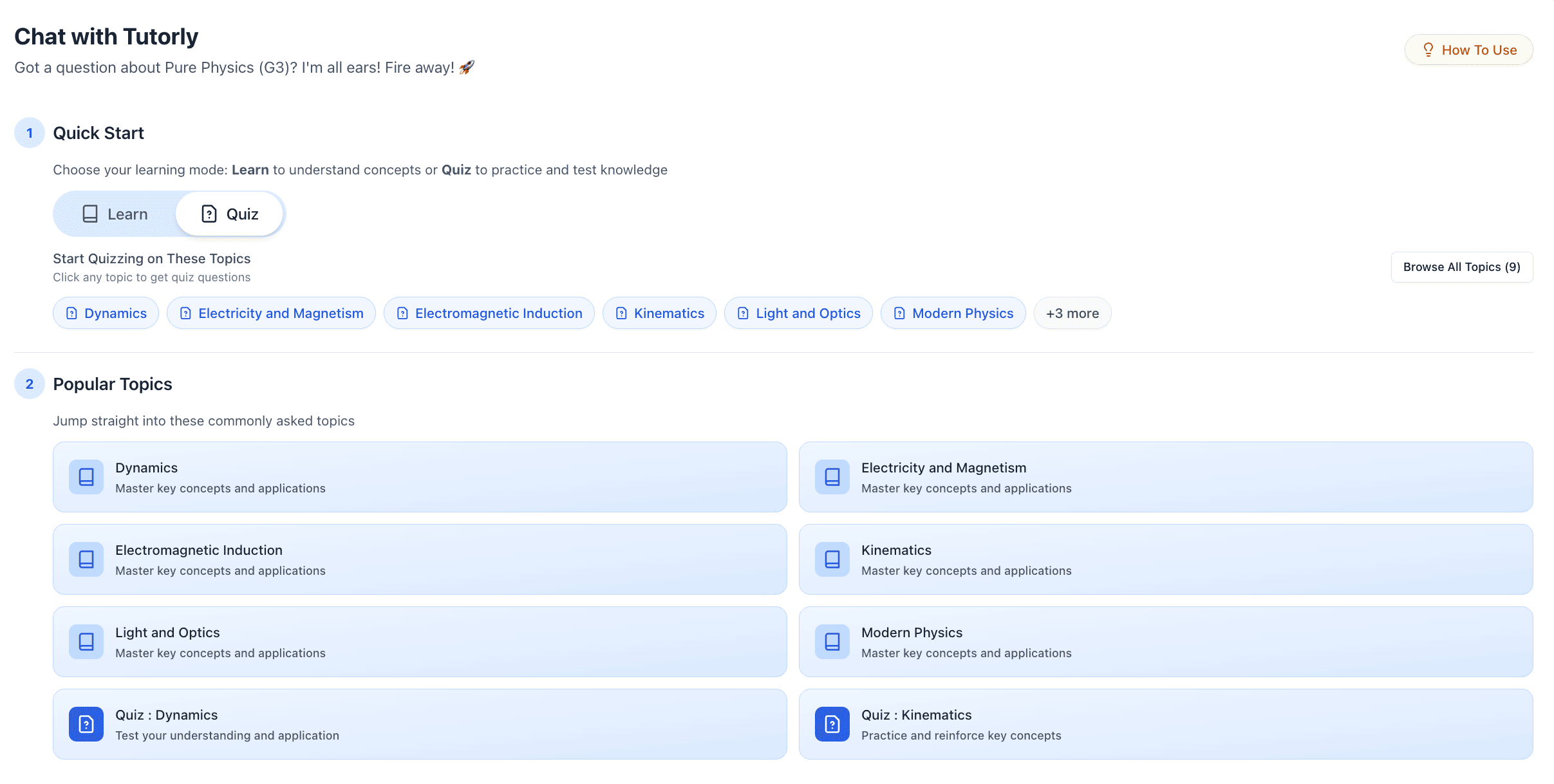 #### 𝑄6 (Moderate – 𝑃5/𝑃6 Forces) 𝐴 book is resting on 𝑎 table. Describe the forces acting on the book and explain why it does not move. **Hard variant (More advanced reasoning)** The same book is now pushed gently but does not move. Explain, in terms of forces, why the book remains at rest even though 𝑎 force is applied. Look for: - Mention of balanced forces - Friction - Resultant force being zero --- If your child struggles with the **hard variants**, that’𝑠 𝑎 sign they need: - More exposure to higher-order questions (tuition centre / strong tutor) - Or frequent, on-demand practice with clear explanations (Tutorly) You can let them try asking one of these hard questions to Tutorly right now: [https://tutorly.sg/app](https://tutorly.sg/app) --- ## Common mistakes when choosing primary school tuition in Singapore Let’𝑠 save you some time (and money). These are the mistakes 𝐼 see most often. ### 1. Choosing based only on “famous” brand or friend’𝑠 recommendation 𝐴 centre or tutor can be excellent, but: - Your child may not click with the teacher’𝑠 style - The pace may be too fast or too slow - Class size might be too big for 𝑎 weaker student Always: - Ask for 𝑎 **trial lesson** if possible - Talk to your child after: “Did you understand more? Did you feel okay asking questions?” And remember, some kids open up more to AI because there’𝑠 no fear of being judged. That’𝑠 where Tutorly can complement traditional tuition. --- ### 2. Overloading your child with too many classes 3–4 tuition classes 𝑎 week for 𝑎 𝑃4 child is common now, but not always helpful. Signs your child is overloaded: - Constantly tired - Rushing homework before lessons - No time to revise or play Sometimes, **less is more**: - 1–2 solid tuition sessions - Daily short practice with help from Tutorly when stuck This often leads to better long-term retention and less burnout before PSLE. --- ### 3. Ignoring exam skills and focusing only on content Knowing the syllabus is one thing. Scoring in exams is another. You need tuition that: - Teaches **answering techniques** (especially for Science OEQ and Math word problems) - Gives **timed practice** - Reviews **careless mistakes** and patterns When your child uses Tutorly, encourage them to: - Not just copy the solution - Compare their method with the step-by-step explanation - Ask: “Why is this method better for exams?” --- ### 4. Not checking if the tutor/centre is truly MOE / PSLE aligned Some materials online are based on overseas curricula. Topics, examples, and even methods can be different. Always check: - Are the topics and question formats similar to your child’𝑠 school papers? - Do they use terms like “Booklet 𝐴/𝐵”, “Paper 2”, “model drawing”, “PSLE format”? Tutorly is explicitly built for the **Singapore MOE syllabus**, and covers Primary 1 all the way to JC2. That’𝑠 why it’𝑠 been noticed by local media like **CNA** and adopted by **thousands of users in Singapore**. --- ### 5. Waiting until 𝑃6 to “suddenly” start tuition 𝐼 see many cases like this: - 𝑃3–𝑃5: “We’ll see how first, no tuition yet.” - 𝑃6 Term 1: “Suddenly” realise there are huge gaps in fractions, ratio, grammar, and Science concepts. Catching up 3 years of gaps in 9 months is stressful for everyone. Better approach: - Light support from 𝑃4 or 𝑃5 (maybe 1 subject with 𝑎 tutor/centre) - Use Tutorly from 𝑃3/𝑃4 onwards for homework questions and revision This builds 𝑎 strong foundation before the PSLE crunch year. --- ## Final thoughts: So what is the “best” primary tuition in Singapore? There is no one-size-fits-all answer, but you can make 𝑎 smart decision by asking: 1. What is my child’𝑠 **real problem**? (content, exam skills, or confidence) 2. Which format suits their **personality and schedule**? 3. Does this option clearly follow the **MOE syllabus and PSLE format**? 4. Is the **cost sustainable** for our family? 5. Do we have 𝑎 plan for the **“𝐼’𝑚 stuck now” moments** between lessons? For many families, the most effective setup ends up being: - **One consistent human teacher** (private tutor or tuition centre) - **One always-available AI tutor** ([Tutorly.sg](https://tutorly.sg/app)) for daily questions and revision This combination gives your child: - Personal guidance - Structured lessons - \frac{24}{7} MOE-aligned support whenever they’re stuck --- ## Try [Tutorly.sg](https://tutorly.sg/app) for your primary school child If you want to see how an AI tutor designed specifically for Singapore students can fit into your child’𝑠 routine: - Learn more about how it works here: [https://tutorly.sg/ai-tutor-singapore](https://tutorly.sg/ai-tutor-singapore) - Or let your child start asking questions immediately here: [https://tutorly.sg/app](https://tutorly.sg/app) It’𝑠 not 𝑎 mobile app, just 𝑎 website — so your child can use it on any browser, anytime, for Primary 1 all the way to PSLE and beyond. --- > “Practice PSLE Science questions and get clear, step-by-step answers instantly.” > [👉 Try 𝑎 question now and see how fast you can improve.](https://tutorly.sg/app)  ## Ready to practise? If you want 𝑎 Singapore-focused AI tutor you can use immediately (website, no sign-up), try Tutorly here: - [https://tutorly.sg/ai-tutor-singapore](https://tutorly.sg/ai-tutor-singapore) - [https://tutorly.sg/app](https://tutorly.sg/app) --- ## Related Articles - [Best Primary Math Tuition in Singapore: 𝐴 Practical Guide for Busy Parents](/blog/best-primary-math-tuition-singapore) - [How To Choose The Best Primary Tuition Centre In Singapore (And 𝐴 Smarter Alternative)](/blog/best-primary-tuition-centre-in-singapore) - [How To Choose The Best Science Tutor In Singapore (Secondary & 𝑂 Levels)](/blog/best-science-tutor-singapore)
Free on Tutorly.sg
Practise with step-by-step help — free to start
On Tutorly.sg/app you can practise unlimited Singapore syllabus questions, get instant explanations when you are stuck, and use past-year papers — no sign-up needed to start.
- ✓ PSLE, O Level, A Level, and more
- ✓ Step-by-step working when you are stuck
- ✓ Works on phone and laptop